
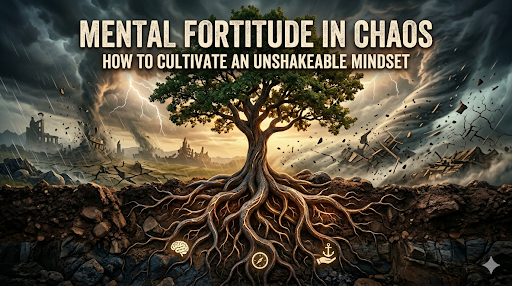
Yesterday, we talked about the philosophy of the Iron Root. The invisible, deep-soil work required to stay anchored when the world gets stormy. But before you buy a single emergency supply, plant a seed, or audit your household budget, there is a piece of equipment you must master first.
It’s the space between your ears.
In any crisis, your mindset is either your greatest asset or your heaviest liability. Whether it’s a sudden natural disaster, an economic downturn, or a chaotic day where everything goes wrong at once. Panic, denial, and a victim mentality will paralyze you faster than any grid failure.
True resilience isn’t just about what you have in your pantry; it’s about who you are when the walls start closing in. Here is how we build mental fortitude from the ground up.
The Psychological Trap of ‘Normalcy Bias’
The greatest enemy of mental preparedness is a psychological phenomenon known as normalcy bias. This is the brain’s tendency to underestimate both the likelihood of a disaster and its potential effects. Essentially, your brain tells you, “Everything has always been fine, therefore everything will continue to be fine.”
When a crisis hits, people trapped in normalcy bias don’t act. They freeze. They wait for someone in authority to tell them what to do. They waste precious minutes convincing themselves that the smoke isn’t real or the market will instantly rebound.
Breaking free from normalcy bias doesn’t mean becoming paranoid; it means becoming pragmatic. It’s the willingness to look reality square in the eye, accept it for what it is. Not what you wish it was. And make a decisive move.
The Blueprint for an Unshakeable Mindset
Cultivating mental fortitude is a daily practice. You don’t want to try out your mental coping strategies for the first time during an actual emergency. You build the muscle now, in the quiet moments, using three core principles:
1. Extreme Ownership
The moment you blame outside forces for your stress or lack of preparedness, you hand over your power. Shift your internal dialogue from “Why is this happening to me?” to “Given these circumstances, what is the best move I can make right now?” This single shift moves you from a passive victim to an active strategist.
2. Tactical Breathing and Physiological Control
When chaos hits, your sympathetic nervous system fires off, flooding your body with cortisol and adrenaline. Your heart rate spikes, your vision narrows, and your rational brain shuts down. To regain control, use Box Breathing:
- Inhale deeply through your nose for 4 seconds.
- Hold that breath for 4 seconds.
- Exhale slowly through your mouth for 4 seconds.
- Hold empty for 4 seconds.
Repeating this cycle just three or four times sends a physiological signal to your brain that you are safe, allowing your logical mind to come back online.
3. Control the Controllables
In a chaotic situation, 90% of the variables are completely out of your hands. If you focus on the macro-chaos, you will spiral. Shrink your perimeter. Focus entirely on the 10% you can control: your attitude, your immediate next step, and your care for the people right next to you.
The Daily Discipline of Micro-Stress
You cannot build an unshakeable mindset living a life of pure comfort. To build iron roots, you must intentionally introduce small, manageable stressors into your routine.
Whether that’s taking a cold shower, pushing through a grueling workout when you don’t feel like it, waking up an hour earlier to study, or spending a weekend completely off-grid and unplugged, intentional discomfort hardens your psychological shell. It teaches your brain a vital lesson: I can be uncomfortable, and I can still execute.
Mindset Check: Think back to the last time a plan fell apart or unexpected chaos hit. Did you freeze, panic, or pivot? Identify one way you can practice “controlling the controllables” during a stressful moment this week. Turn the comment section into a masterclass in mental toughness below.