
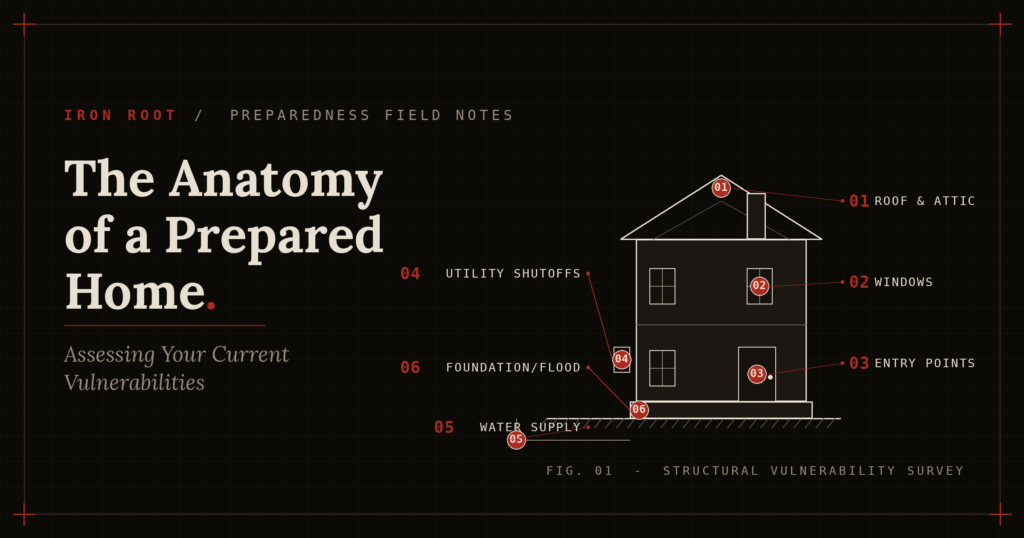
Over the last few days, we’ve laid down the mental groundwork. We talked about philosophy, mindset, and breaking our addiction to blind convenience. Now, it’s time to pick up a clipboard, walk through your front door, and get practical.
It’s time to conduct a Home Vulnerability Audit.
Most people approach emergency preparedness backwards. They watch a disaster movie, get a wave of anxiety, and rush online to buy a random assortment of tactical gear, freeze-dried meals, and gadgets they don’t know how to use. They treat preparedness like a shopping trip rather than a strategy.
True security doesn’t start with buying things; it starts with analyzing what you already have—and identifying exactly where your walls are thin.
The Layered Defense Framework
To properly assess your home, you need to look at it through a framework of layers, moving from the outside in. Your home isn’t just a building; it’s a self-contained ecosystem that keeps your family safe, warm, and fed.
When the outside world becomes unstable, your home needs to act as a resilient fortress. Let’s break down the four critical layers you need to audit today.
Layer 1: Structural Security & Perimeter
Before looking at supplies, look at physical security. If your home cannot be secured against external threats or severe weather, your supplies won’t matter.
The Audit: Walk outside your house. Look at it through the eyes of a stranger. Are there dark, unlit corners at night? Are your door frames flimsy with short, half-inch screws in the strike plates? Do you have overhanging tree limbs that could take out your roof or power lines during a summer storm?
The Quick Fix: Replace standard door frame screws with 3-inch heavy-duty screws. It takes ten minutes and a drill, but it transforms a door that can be kicked open in seconds into a serious physical barrier.
Layer 2: Water Sovereignty
You can live for weeks without food, but in a grid-down or contaminated-utility scenario, water becomes a crisis within 72 hours.
The Audit: If the municipal water supply shut off right now, how many gallons of clean, potable water do you have on hand? Do you have a secondary way to purify water that doesn’t require electricity?
The Target: Aim for a bare minimum of 1 gallon of water per person, per day, stored for a 3- to 7-day window. If you haven’t checked your water backup plan lately, this is your baseline.
Layer 3: Energy & Environment
When the power grid fails in the dead of winter or the blistering heat of June, your home’s climate quickly becomes unlivable without a backup plan.
The Audit: What is your plan if the power goes out for 48 hours during a summer heatwave? Do you have analog backup lighting (headlamps, lanterns) with fresh batteries? Can you charge communication devices or run a medical device if necessary?
The Target: Identify your primary backup power needs. Moving beyond flashlights means understanding basic solar generators, traditional fuel generators, or manual cooling and heating alternatives.
Layer 4: The Resilient Pantry
Food security isn’t about hoarding survival rations for an apocalypse; it’s about having a deep, rolling buffer of real food that your family actually eats.
The Audit: Open your pantry. If you couldn’t go to the grocery store for the next two weeks, would your family eat balanced, nutrient-dense meals, or would you run out of fresh items by day four? Do you rely entirely on a deep freezer that will thaw if the power cuts out?
The Target: Focus on a “store what you eat, eat what you store” model. Build a baseline of shelf-stable, nutrient-dense ingredients—canned proteins, healthy fats, and low-carb staples—that require minimal cooking energy.
Action Step: The 24-Hour Walkthrough
Your homework today is simple but eye-opening. Take 15 minutes to walk through your home with a notepad. Write down your top three weakest points across these four layers.
Don’t panic if the list looks long. Every single master of self-reliance started exactly where you are standing right now. The goal today isn’t to be perfectly protected; it’s to stop guessing and start knowing.
Audit Check: What is the number one vulnerability you discovered during your walkthrough today? Is it water storage, flimsy door locks, or an empty pantry? Share your focus area in the comments below, and let’s talk about how to fix it cheaply and efficiently.